
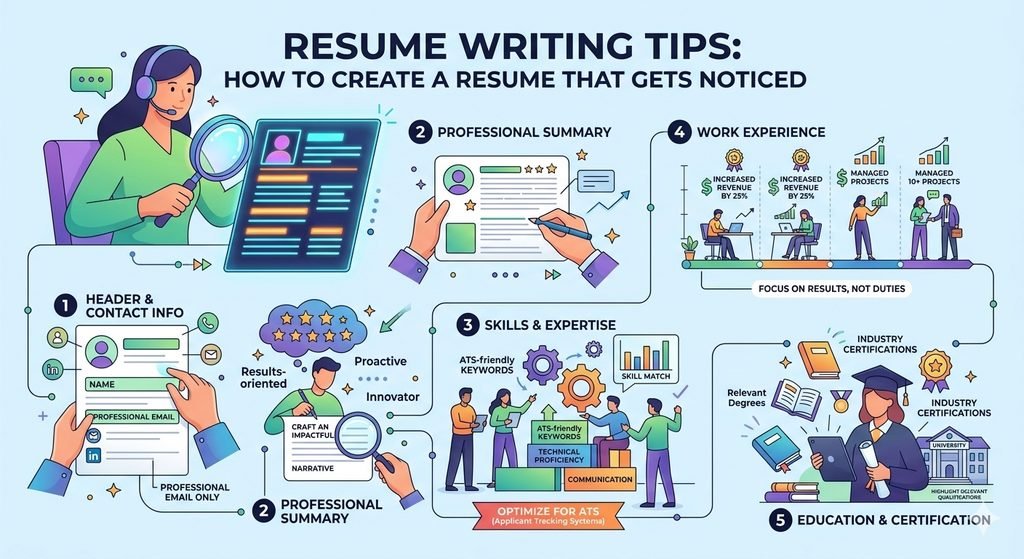
Writing a strong resume is one of the most important steps in your job search. Your resume should quickly show employers what you can do, what you have achieved, and why you are a good fit for the role. Use these practical resume writing tips to create a clear, professional, and effective resume.
1. Start With a Clear Resume Structure
A well-organized resume is easier to read and helps recruiters find important information quickly. Use clear sections such as:
- Contact information
- Professional summary
- Work experience
- Education
- Skills
- Certifications, awards, or relevant projects
Use consistent headings, spacing, font sizes, and date formats throughout the document.
2. Write a Strong Professional Summary
Your professional summary should be a short introduction at the top of your resume. Mention your experience, key strengths, and the type of value you can bring to an employer.
For example, instead of writing “Hardworking professional seeking a challenging position,” write something specific such as: “Customer service specialist with five years of experience improving client satisfaction, resolving complex issues, and training support teams.”
3. Tailor Your Resume to Each Job
A generic resume is less effective than one tailored to the position. Read the job description carefully and identify the skills, qualifications, and keywords the employer emphasizes. Adjust your summary, skills section, and experience descriptions to highlight the most relevant information.
4. Focus on Achievements, Not Just Responsibilities
Employers want to know what results you achieved, not only what tasks you completed. Describe your accomplishments using action verbs and measurable outcomes whenever possible.
For example:
- “Managed social media accounts” can become “Increased social media engagement by 40% in six months.”
- “Answered customer questions” can become “Resolved an average of 60 customer inquiries per day while maintaining a 95% satisfaction rating.”
5. Use Strong Action Verbs
Begin bullet points with clear action verbs that show your contribution. Examples include:
- Achieved
- Created
- Developed
- Improved
- Managed
- Organized
- Reduced
- Streamlined
- Trained
- Launched
Avoid repeating the same verb throughout your resume.
6. Include Relevant Skills
List skills that are relevant to the job you want. Include a balanced combination of technical and soft skills, such as software proficiency, data analysis, communication, project management, problem-solving, or leadership.
Prioritize skills mentioned in the job posting, but only include skills you genuinely possess. Be prepared to discuss each important skill during an interview.
7. Keep the Design Professional
Your resume design should support your content rather than distract from it. Use a clean layout, readable fonts, and enough white space. Avoid excessive colors, decorative graphics, complicated columns, and hard-to-read fonts unless you are applying for a design-focused role.
For most applicants, a one-page resume is appropriate. Candidates with extensive experience may use two pages if every section adds value.
8. Optimize Your Resume for Applicant Tracking Systems
Many employers use applicant tracking systems to scan resumes before a recruiter reviews them. To improve compatibility:
- Use standard section headings such as “Work Experience” and “Education.”
- Include relevant keywords from the job description.
- Avoid placing important information inside images, charts, headers, or footers.
- Use a simple file format requested by the employer, usually PDF or Word.
9. Proofread Carefully
Spelling, grammar, and formatting mistakes can make a negative impression. Read your resume several times, check company names and dates, and ask someone you trust to review it. Reading the document aloud can also help you notice awkward wording and missing words.
10. Be Honest and Accurate
Never exaggerate your experience, qualifications, job titles, or achievements. Employers may verify the information on your resume, and inaccurate claims can damage your credibility. Present your experience confidently while keeping every detail truthful.
Resume Checklist
Before submitting your resume, confirm that it:
- Matches the job you are applying for
- Includes current contact information
- Has a clear and concise professional summary
- Highlights measurable achievements
- Uses consistent formatting
- Contains relevant keywords and skills
- Is free of spelling and grammar errors
- Uses the file format requested by the employer
Conclusion
A successful resume is clear, relevant, and focused on the value you can provide. By tailoring your content, emphasizing achievements, using a professional design, and proofreading carefully, you can create a resume that makes a stronger impression and improves your chances of reaching the interview stage.
